Getting replacement filters right the first time saves downtime, freight, and a second order. Most fit problems come from a few avoidable mistakes: confusing flat width with diameter, measuring a stretched or shrunk used bag, or missing the top style. This guide walks through what to measure on dust collector bags, pleated cartridges, and liquid filter bags, and what to include when you request a quote.
Before You Measure
- Look for a part number first. Check the bag or cartridge label, the end cap, the collector nameplate, the maintenance manual, and old purchase orders. An OEM or supplier part number is often the fastest way to an exact match.
- Measure a new spare if you have one. Used bags can stretch, shrink with heat, or distort. If you only have a used bag, clean it off and lay it flat.
- Measure the hardware, too. The tubesheet hole, cage, and cell plate do not change size, so they are reliable references.
- Follow your lockout procedure. Isolate and lock out the collector, shut off and bleed the compressed air supply, and use proper PPE before entering a collector or pulling filters.
Dust Collector Filter Bags
Diameter vs. flat width
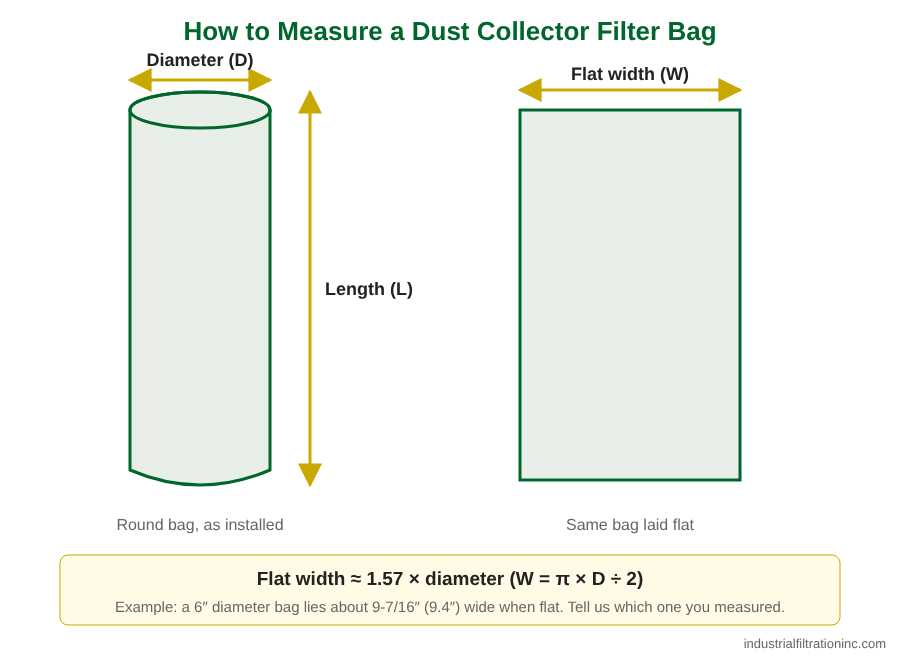
A filter bag laid flat shows its flat width, which is half the circumference. To convert:
- Diameter = (flat width × 2) ÷ 3.1416
- Flat width = (diameter × 3.1416) ÷ 2
For example, a bag with a flat width of about 9.4 inches has a diameter of about 6 inches. Always tell your supplier which measurement you are giving. Bags are made slightly larger than the cage so they fit without being too tight or too loose, so the cage diameter is useful information but is not the same as the bag diameter.
Length
Measure from the very top of the bag (including the snap band or collar) to the bottom seam, with the bag laid flat and not stretched. If you are working from the cage, note the cage length and the top style; the bag is normally sized to suit the cage and tubesheet.
Top style
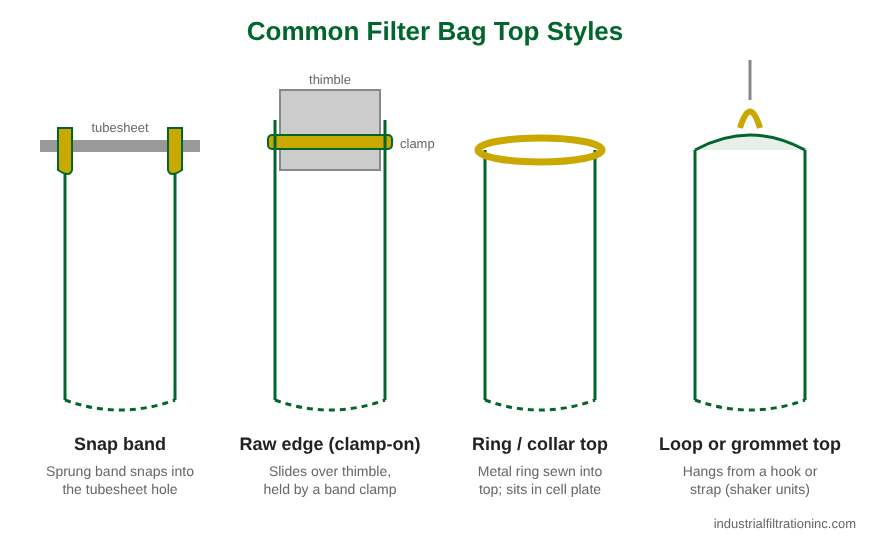
The top determines how the bag seals to the tubesheet or cell plate. Identify yours before ordering.
| Top style | What it looks like | What to measure or note |
|---|---|---|
| Snap band | A spring steel band sewn into a cuff, which snaps into the tubesheet hole | Tubesheet hole diameter and tubesheet thickness |
| Raw edge / open top | Plain open end, secured with a clamp over a thimble or collar | Thimble outside diameter and bag length |
| Ring or collar top | A metal ring sewn into the top, sometimes with a cuff | Ring outside diameter and how the ring sits in the cell plate |
| Grommet / hanger top | A closed or flat top with grommets or a loop for a hanger, common on shaker and reverse air bags | Grommet spacing, hanger style, and overall length |
| Clamp top | Top cuff designed to slide over a thimble and be held by a band clamp | Thimble diameter and cuff length |
Bottom style
Note whether the bottom is a flat sewn disc, a gathered or envelope bottom, a snap band or ring (common on bottom-load or reverse air bags), or reinforced with an extra wear cuff. Also note any wear strips or cuffs along the body.
Media and cages
Record the media if you know it (polyester, aramid, PPS, membrane, and so on). If you are also replacing cages, measure the cage diameter, length, number of vertical wires, ring spacing, top style (flanged, split collar, venturi), and bottom pan. Note the cage material, such as galvanized, carbon steel, or stainless.
Pleated Cartridge Filters

Cartridges have more fit details than bags. Measure and note:
- Outside diameter (OD) of the end caps.
- Inside diameter (ID) of the open end, through the gasket.
- Overall length, end cap to end cap, including any gasket.
- End caps: one end open and one closed, or both open. Note any center hole in a closed cap for a yoke or threaded rod, and its diameter.
- Mounting: horizontal or vertical; held by a yoke and knob, threaded rod, twist-lock (bayonet) tabs, or clamped flange. Count and measure any lugs.
- Gasket: location (on the face of the cap or around the ID), material, and approximate thickness.
- Flange: for flanged cartridges, note flange OD, bolt pattern, and thickness.
- Media: cellulose blend, spunbond polyester, nanofiber surface, membrane, flame retardant, or conductive. Pleat count and depth help confirm a match.
Photos of both end caps and the mounting hardware are especially helpful for cartridges.
Liquid Filter Bags and Cartridges
Liquid filter bags commonly follow standard sizes that fit standard housings. Typical nominal dimensions are below; confirm against your housing.
| Size | Approx. diameter | Approx. length |
|---|---|---|
| #1 | 7 in | 16 in |
| #2 | 7 in | 32 in |
| #3 | 4 in | 8 in |
| #4 | 4 in | 14 in |
Also note the ring or flange type (steel ring, plastic flange, sewn-in collar), the micron rating, the media (polypropylene or polyester felt, nylon monofilament mesh), and any handles. For liquid cartridges, give length (often 10, 20, 30, or 40 inches nominal), OD, micron rating, construction (melt-blown, string wound, pleated), and the end configuration, such as double open end or a specific O-ring style.
What to Send for a Quote
- Any existing part number (OEM or supplier) and the collector or housing make and model
- Dimensions, stating diameter or flat width, plus length
- Top and bottom style, or end cap and mounting details for cartridges
- Media and finish, if known, plus operating temperature and a description of the dust or liquid
- Quantity per change-out and how often you change them
- Clear photos of the label, top, bottom, and mounting hardware
- Ship-to location and any required delivery date
Let Us Help You Match It
Industrial Filtration has helped plants find replacement filters since 1956. If you have an OEM part number, an old label, or just a set of measurements, call us at 562-436-4228 or email info@industrialfiltrationinc.com. We will help you match the part and get you a quote.
