When you order replacement filter bags, the top style matters as much as the diameter and length. The top is what seals the bag to the tubesheet or cell plate, and a bag with the wrong top simply will not install, or worse, will install and leak. This guide explains the most common top styles, how to tell which one your collector uses, and what to measure for each.
Why the Top Style Matters
A dust collector separates the dirty-air side from the clean-air side with a steel plate called a tubesheet (or cell plate in some designs). Every filter bag must seal tightly to that plate. If dust can slip past the top, the collector will leak no matter how good the media is. The top style is determined by the collector design, so the goal is to match what is already there. Pulse jet, shaker, and reverse-air collectors each tend to use different styles, and some designs vary by manufacturer.
Snap-Band Tops
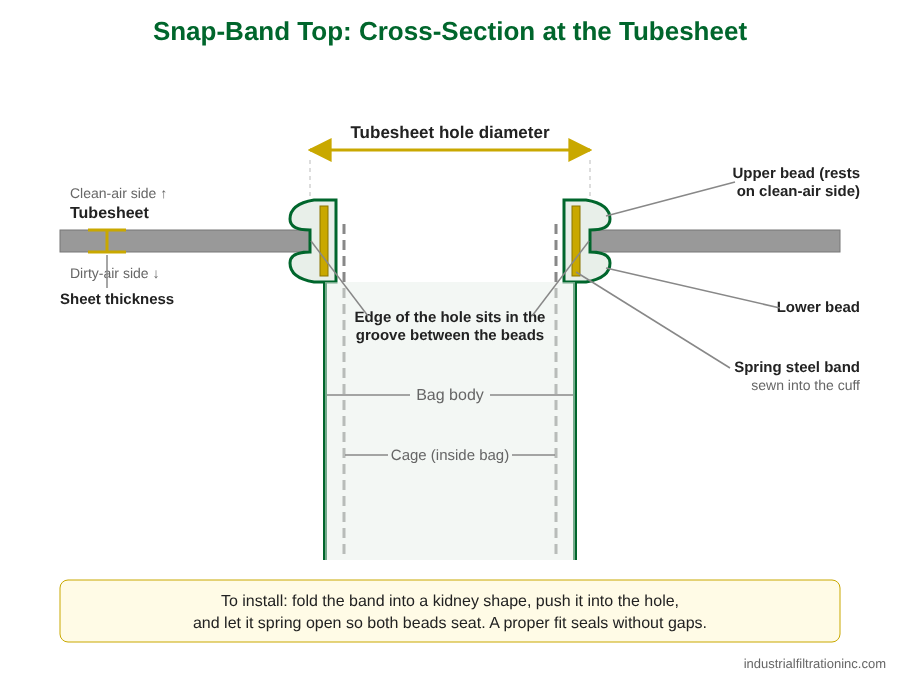
Snap-band bags are the most common style on modern top-load pulse jet collectors. The top of the bag has a cuff with two raised beads and a groove between them. A spring steel band is sewn inside the cuff.
To install, you fold the band into a kidney shape, push it into the tubesheet hole, and let it spring open. The upper bead rests on the clean-air side, the lower bead sits beneath the tubesheet, and the edge of the hole locks into the groove. The cage then drops in through the bag from above, with its top resting on the bag cuff.
Snap bands are made to fit a specific hole diameter and, because the groove has to grip the plate, a specific tubesheet thickness. A band that is too small can leak or pull out; one that is too large is hard to install and may not seat. When fitting new bags:
- Run a finger around each top to confirm both beads are seated all the way around.
- Avoid prying with screwdrivers or other sharp tools that can cut the fabric.
- Clean buildup out of the holes first, and check for dents or out-of-round holes.
Raw Edge and Clamp-Top Bags
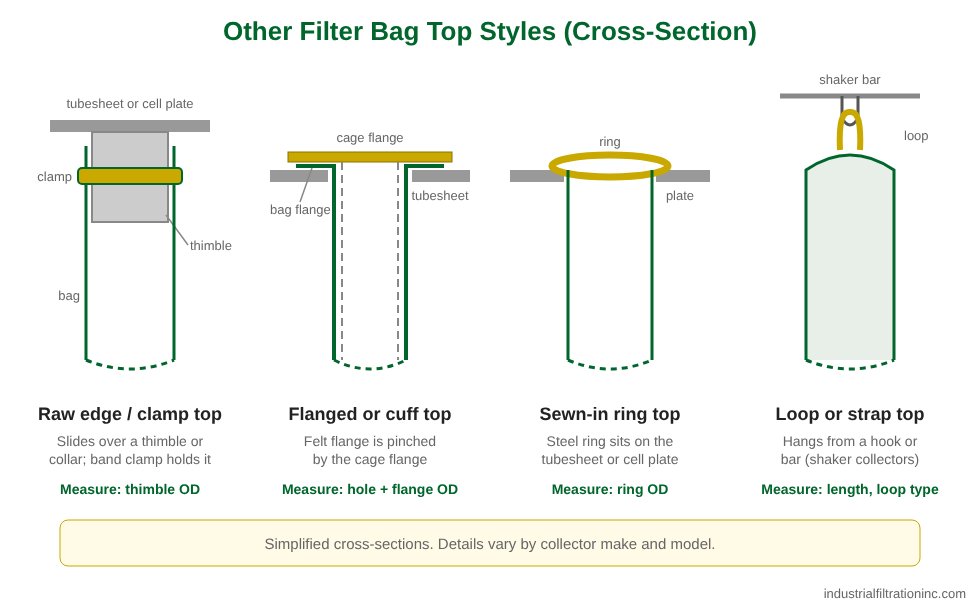
A raw edge or clamp-top bag has an open top, often with a reinforced cuff, that slides over a short metal tube called a thimble or collar. A band clamp, commonly a worm-drive hose clamp, tightens the fabric onto the thimble. Some clamp-top bags have extra layers or a sewn-in bead to help the clamp grip.
This style is common at the cell plate end of shaker and reverse-air bags, and on some older or bottom-load pulse jet designs. It is simple and forgiving, but the seal depends on the clamp. Use clamps in good condition, tighten them evenly, and make sure the cuff covers enough of the thimble.
To measure: the outside diameter of the thimble, the cuff length, and the overall bag length.
Flanged and Cuff Tops
A flanged top has a flat ring of felt or fabric at the top of the bag. The bag drops through the tubesheet hole, the flange rests on the tubesheet around the hole, and the flange of the cage, or a separate hold-down ring, clamps it in place. Some designs use a folded cuff that serves the same purpose.
Flanged tops are found on some top-load pulse jet collectors, often older designs that predate snap bands. Since the seal relies on the flange being pinched flat, check that cage flanges are not warped and that hold-down hardware is complete.
To measure: the tubesheet hole diameter, the flange outside diameter, and the bag length below the flange.
Ring Tops
Some bags have a metal ring sewn into the top. The ring either rests on the tubesheet or cell plate or snaps into a groove or collar. Rings show up in certain pulse jet and reverse-air designs. Do not confuse a top ring with the anti-collapse rings sewn along the length of many reverse-air bags, which keep the bag from collapsing during cleaning.
To measure: the ring outside diameter, how the ring sits in the plate, and the overall length.
Loop, Strap, and Cap Tops
Shaker and reverse-air collectors filter dust on the inside of the bag. The open end of the bag attaches at the bottom, usually with a clamp or snap band at the cell plate, and the closed top hangs from the support structure. The top may have a sewn loop, a strap, grommets, or a metal cap with a hook. Reverse-air bags are often hung with a tensioning device so they stay taut.
With these bags, record both ends. The bottom connection seals the bag, and the top style and length determine how it hangs and how much tension it has.
To measure: the overall length, the loop or cap style and any grommet spacing, and the bottom connection details.
How to Tell Which Top Style You Have
| What you see | Likely top style |
|---|---|
| Bags drop into holes from the clean-air side, held in by a sprung band, with no clamps | Snap band |
| A band or hose clamp around the bag where it meets a short metal tube | Raw edge / clamp top |
| A flat fabric ring under the cage flange or a hold-down ring | Flanged or cuff top |
| A rigid metal ring sewn into the top | Ring top |
| Bags hang from hooks, bars, or a shaker frame and attach to a plate at the bottom | Loop, strap, or cap top |
If you have a used bag in hand, look at the top: a stiff band inside a beaded cuff is a snap band, an open cuff is a clamp top, and a closed top with a loop or cap is a hanging bag. The collector manual or a past order will confirm it.
For full step-by-step measuring instructions, including diameter versus flat width and bottom styles, see our guide on how to measure a replacement filter bag or cartridge. To choose the fabric, see how to choose dust collector filter bag media.
Need Help?
Industrial Filtration has supplied dust collector filter bags since 1956. If you are not sure which top style your collector uses, call us at 562-436-4228 or email info@industrialfiltrationinc.com. Send us photos of the bag top and the tubesheet or cell plate, along with any measurements or part numbers you have, and we will help you match it.
